

Quick Summary
It’s fair to ask: If your organization has a preponderance of B Players—employees who, by definition, are not living up to either the required performance standard or their full potential—whose fault is it? Is it the managers’ or the employees’?
The truth is that poor performance is usually the result of a non-coaching manager, a non-coachable employee, or both. This means that one or both sides of the performance equation is off:
- A non-coaching manager who struggles to select talent, set clear expectations, provide a proven playbook, or coach people to A Player performance.
- A non-coachable employee who lacks the accountability, desire, or willingness required to improve.
Diagnosing why you aren’t getting the A Player performance your organization deserves is straightforward. Evaluate the quality of the coaching provided by managers and the coachability of employees, and you’ll quickly see where the problems and opportunities lie.
Key Takeaways
- Great leadership of your team is as simple as coaching to (not managing to) a strong playbook that teaches skills, process, and technique.
- Fundamentally, the difference between an A Player and a B Player is coachability.
- You only need managers on your team who can improve employee performance through coaching. If they can’t improve the performance of their people, you don’t need them.
- A Player coaches lead with care and coach with clarity. They use facts, metrics, and observed behaviors to help people improve—not opinions, assumptions, frustration, or emotion.
- Coaching without measurable improvement is simply cheerleading. Great coaches define exactly what winning looks like, establish clear performance measures, and track progress until the desired result is achieved.
At the Crux of the B Player Problem: Coaching, Coachability, and the Lack Thereof
CEOs who want to scale up successfully need to get the four decisions of Scaling Up right: People, Strategy, Execution, and Cash. The foundation of these four decisions is People. Unless you know how to attract and keep A Players, you won’t be able to master the other three.
Unfortunately, many CEOs have been sold a bill of goods that B Player performance is fine. Not so. As my colleague Krista Wade so eloquently says, “B Players are the fast track to mediocrity.” It doesn’t have to be this way! For the same or similar money, you can develop a team of 100% A Players.
When you see B Players in your organization, it’s fair to ask: Whose fault is this, the managers’ or the employees’? This simple analysis will quickly identify the root cause of underperforming employees so you can address it right away.
Fundamentally, the difference between an A Player and a B Player is coachability: the willingness and ability to learn, grow, accept correction, and develop new skills.
Managers are usually culpable when employees fail. They may have selected the wrong person, failed to train and coach new hires properly, given them no clear expectations, or provided no proven system for the employee to follow.
That’s why developing A Players begins with an A Player manager who knows how to coach. Verne Harnish and I are now calling managers “Player-Coaches” to underscore the need for both firsthand expertise and the need to be a force multiplier. The days of simply managing “work” are over!
The Definition of a Coach
A coach sees more in people than they see in themselves, asks powerful questions, and guides and challenges employees to unlock their potential. A great coach gets more out of people than they knew they had to give.
But even a great coach cannot develop someone unwilling to be coached. Coaching and coachability are two sides of the same performance equation. The manager must be capable of teaching, guiding, challenging, and correcting, while the employee must be willing and able to respond.
When the manager has a strong playbook, knows how to coach, is committed to developing people, and is working with a coachable employee, the formula for success is straightforward.
So, what are the conditions necessary for coachability?
- A proven system, known as a playbook
- A coach who can develop willing people to high performance
- A smart, willing, coachable person
It really is that simple.
For A Players to develop and thrive, two conditions must exist: strong managers who can accurately select and coach talent, and coachable employees with the will and growth mindset to improve. On a graph, it looks like this:
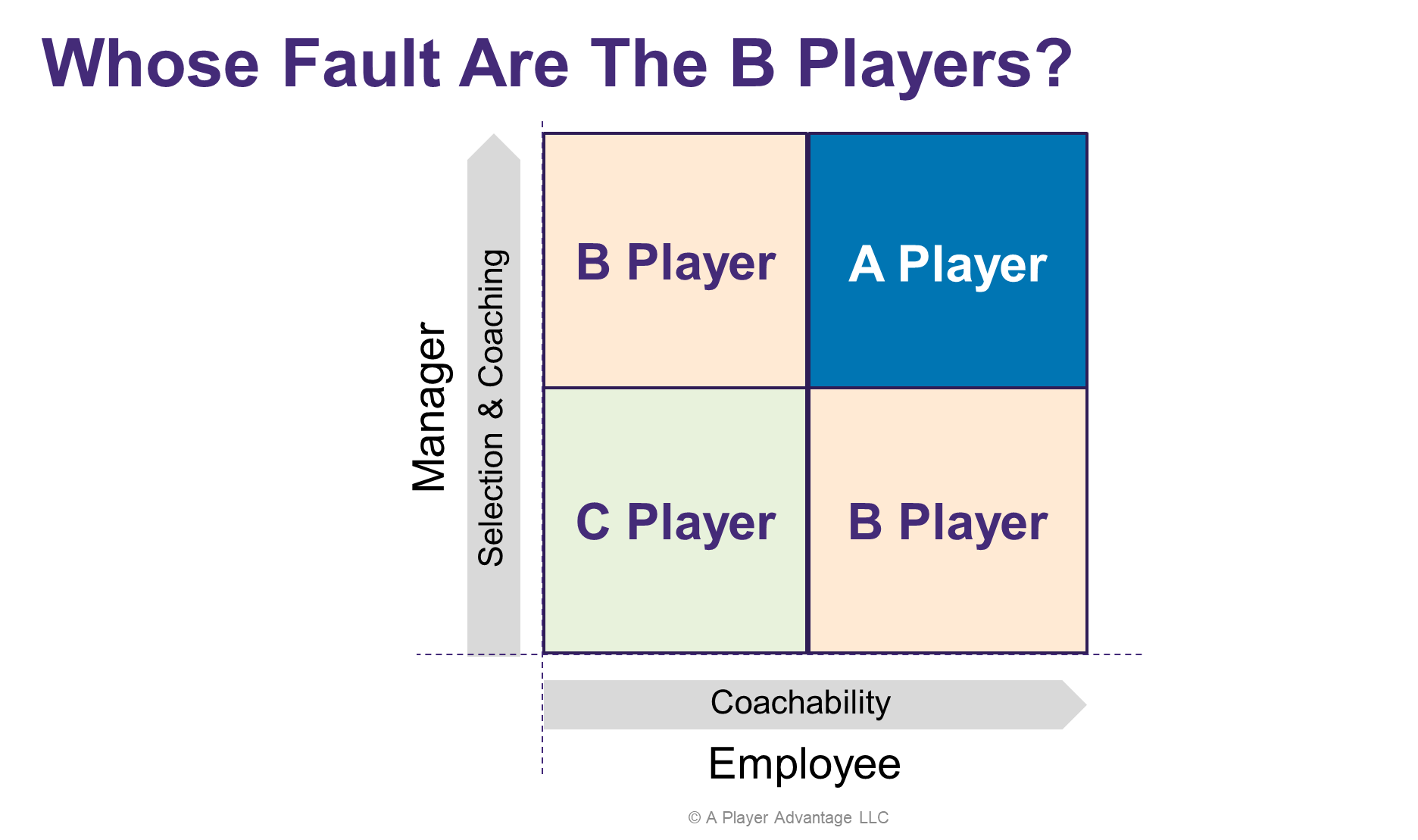
Almost any skill can be improved through the combination of a great coach, a proven method, and a willing student. Cooking, photography, gardening, writing, coding, public speaking, leadership, and sales are not mysterious gifts reserved for the naturally talented. They’re crafts that can be taught, practiced, guided, corrected, and mastered.
Will matters because it measures desire. Someone who isn’t genuinely interested in the work won’t become an A Player in that role. At best, they’ll remain a B Player. At worst, they will become a C Player collecting a paycheck for work they have no desire to master.
Consider sales. Because revenue is the lifeblood of every business, CEOs naturally place a premium on selling skills. Before the chorus of “I hate sales” begins, understand this: strong salespeople are developed, not born. Sales skills are highly trainable in a coachable person.
Assume the organization needs additional revenue. An A Player in operations would recognize the need to help with sales, study the sales playbook, role-play scripts with the sales manager, and become adept at uncovering customer needs, opening opportunities, and converting them into revenue. This A Player would also accept corrections from the sales coach without getting their feelings hurt.
Conversely, B Players wouldn’t recognize the need or take the initiative. If asked to help, they would resist coaching, refuse to follow the proven scripts and systems, and eventually declare, “This doesn’t work for me.”
That employee shouldn’t work for you. And if your managers can’t or won’t make time to coach, get rid of them too. Fingerpointing and amateur hour are officially over.
It’s eminently possible to build a great team filled with A Players. At the heart of that is developing a culture of coaching where great coaches are actively developing hungry, humble, and smart employees who are open to coaching.
Scaling Up is the only performance platform that delivers a fully integrated system to strengthen the People decision. Our Scaling Up A Players system has all the tools to make this happen in your business, and we’re here to help.
What’s Next?
If you’re not already a member
Click Here:
Already a member?
Click Here to Login:
Read The A Player Agreement™ Playbook

Download the Ultimate in Talent Assessment Tools

Let’s Build Together!
If you’re ready to stop settling and start scaling, there has never been a better time to reach out to Rick and the A Player Advantage team. Whether you want to talk about cashflow, hiring 100% A Players, or strategically scaling for exit, A Player Advantage is here to help! Reach out today to get started.

Recent Comments